
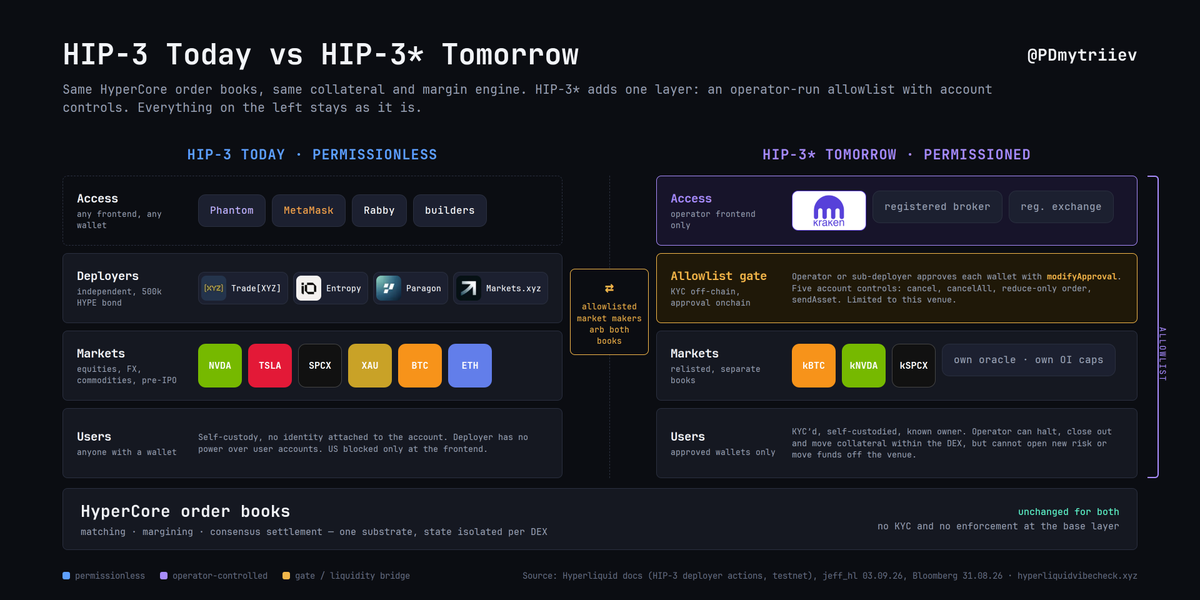
KYC is coming to Hyperliquid. Not to the protocol, but to a new layer on top of it, and Kraken looks like the first one to run it. Hyperliquid has been geoblocked from the US because nobody in its stack could identify a customer, refuse one, or close one out. HyperCore already does the exchange and clearing work; what was missing was a layer where a licensed operator could carry those obligations. HIP-3* is that layer, and it sits beside today's open markets rather than replacing them. A "Kraken HIP-3 test DEX" has been running it on testnet since 19 August. https://t.co/BSo0qoajm4 What is actually in the update: → A deployer can flag a HIP-3 DEX as HIP-3* at creation, which turns on an onchain allowlist. Only approved wallets can trade on that venue. → The operator gets five account controls over approved users: add or remove a wallet, cancel specific orders, cancel all orders and TWAPs, place reduce-only orders, and move collateral between accounts inside the DEX. → Each control can be delegated separately to sub-deployers, so KYC, surveillance and risk desks can hold different keys. → Controls stop at the venue boundary. The operator cannot open new risk for a user, move funds off the DEX, or touch positions on any other DEX. → Markets are relisted as new contracts with their own order book, oracle and OI caps. Same collateral and margin engine, so allowlisted market makers can arb against the open book. → Base layer unchanged: HyperCore still has no KYC and no enforcement. Existing markets and deployers are unaffected, and the protocol fee is still charged on every trade. https://t.co/CV8LQYQJlq A regulated firm can now run a KYC'd venue on HyperCore while @HyperliquidX itself stays neutral infrastructure, which is exactly the shape a @krakenfx deal would need.
Saturday, September 5, 2026 at 11:55 AM UTC
Discussion (0)
Connect wallet to join the discussion.