
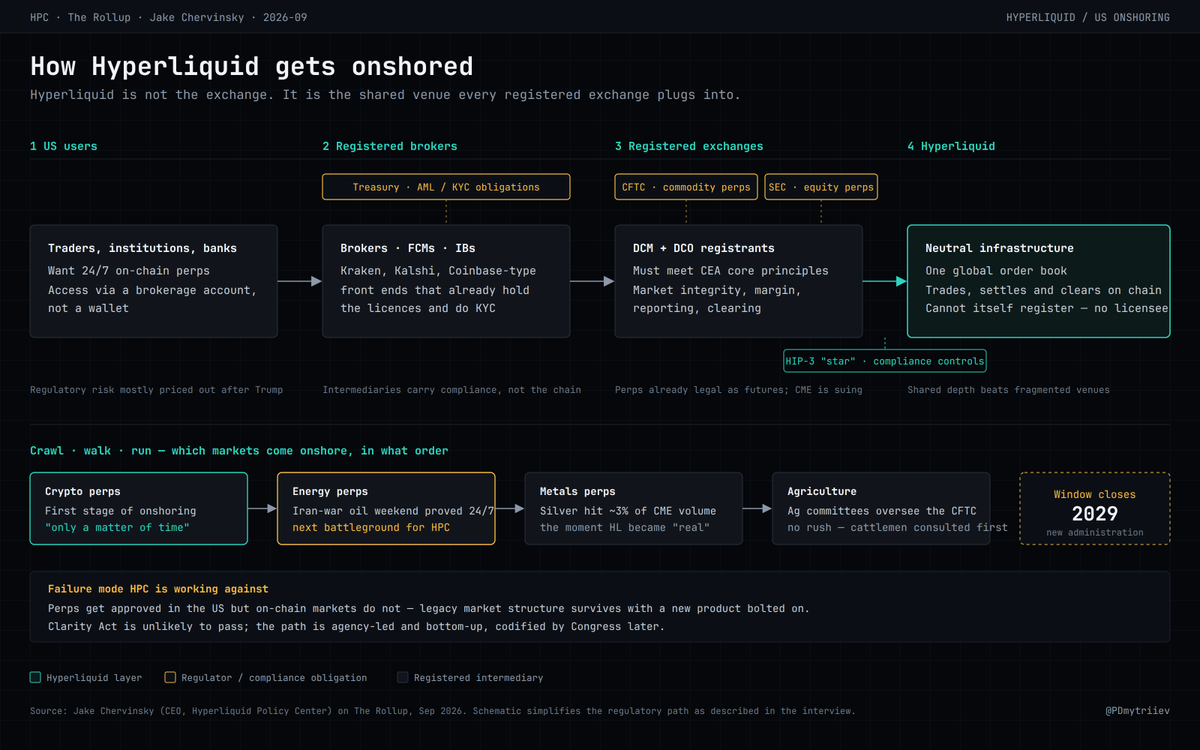
Trump said "Hyperliquid" on national TV, and @jchervinsky says he literally fell out of his chair. Jake Chervinsky, CEO of the Hyperliquid Policy Center, sat down with The Rollup to explain what "onshoring Hyperliquid" actually means in practice: not @HyperliquidX becoming a US exchange, but Hyperliquid becoming the neutral liquidity layer that registered US exchanges and brokers plug into. → The Trump mention was a surprise, not a plan. The press conference was supposed to be about the Clarity Act; Trump ended up praising Atkins and Selig and name-checked Hyperliquid as a CFTC priority. Chervinsky reads it as validation, but stresses nothing is in the bag and the details are still being worked out. → HPC's origin: Chervinsky met Jeff while at a VC firm, became convinced Hyperliquid is the industry's best shot at reshaping global finance, and got a 1M $HYPE grant from the Hyper Foundation. $HYPE's price rise has expanded their war chest. → Perps are already legal in the US. The CFTC reclassified true perpetuals as futures (not swaps) via orders to Coinbase and Kalshi for BTC perps. CME is currently suing the CFTC over this. → The hard problem is on-chain perps, not perps. A permissionless blockchain can't register with the CFTC because there's no person to license. Congress won't pass DeFi legislation soon and blanket exemptive relief is unrealistic, so the path is through existing registrants (DCMs, FCMs, brokers) using Hyperliquid as infrastructure. → Hyperliquid is not a competitor to Kalshi, Coinbase, Robinhood or CME. It's infrastructure they should all use. The pitch to regulators: derivatives markets live on liquidity depth, and fragmenting it across venues gives everyone a worse product. One shared venue is better for the US. → The failure mode that keeps him up at night: perps come onshore but on-chain markets don't, and the US ends up with legacy market structure plus perps. → "HIP-3*": a compliant variant of HIP-3 where deployers or exchanges have enough control to satisfy CFTC core principles, SEC rules for equity perps (which fall under the SEC, not CFTC), and Treasury AML/KYC obligations. Equity perps still face the open question of security futures vs. security-based swaps. → Regulators are aligned: SEC's Project Crypto and Crypto Task Force, CFTC's Innovation Task Force under Selig, plus an SEC-CFTC harmonization MOU. Chervinsky calls first-stage onshoring of crypto-underlying perps "only a matter of time." → Next battleground is energy perps. The Iran war weekend in February, when oil was priced on Hyperliquid while TradFi was closed, is the proof case that this isn't just a crypto product. HPC feels they're "pretty much there" on energy. Silver, not oil, was the first real breakout (~3% of CME silver volume). → Agriculture matters more than crypto people realize. The CFTC is overseen by the House and Senate ag committees, and ag is its core constituency. HPC is engaging groups like the Cattlemen's Beef Association and is deliberately not rushing cattle perps. → On the $USDC deal: he learned about it publicly like everyone else, views Circle and Coinbase as strong policy partners, and sees stablecoins becoming systemically important (Jackson Hole, G20) as proof crypto has left the token-trading sandbox. → Clarity Act is likely dead. He has "very little hope" for a deal. Expect narrow, Genius Act-style bills for products that have earned it, and a bottom-up path where regulators build working markets first and Congress codifies later. → The window is short. Everything needs to be live and used by real people before 2029, when a new administration could try to flip the switch back off.
Tuesday, September 8, 2026 at 07:10 AM UTC
Discussion (0)
Connect wallet to join the discussion.