
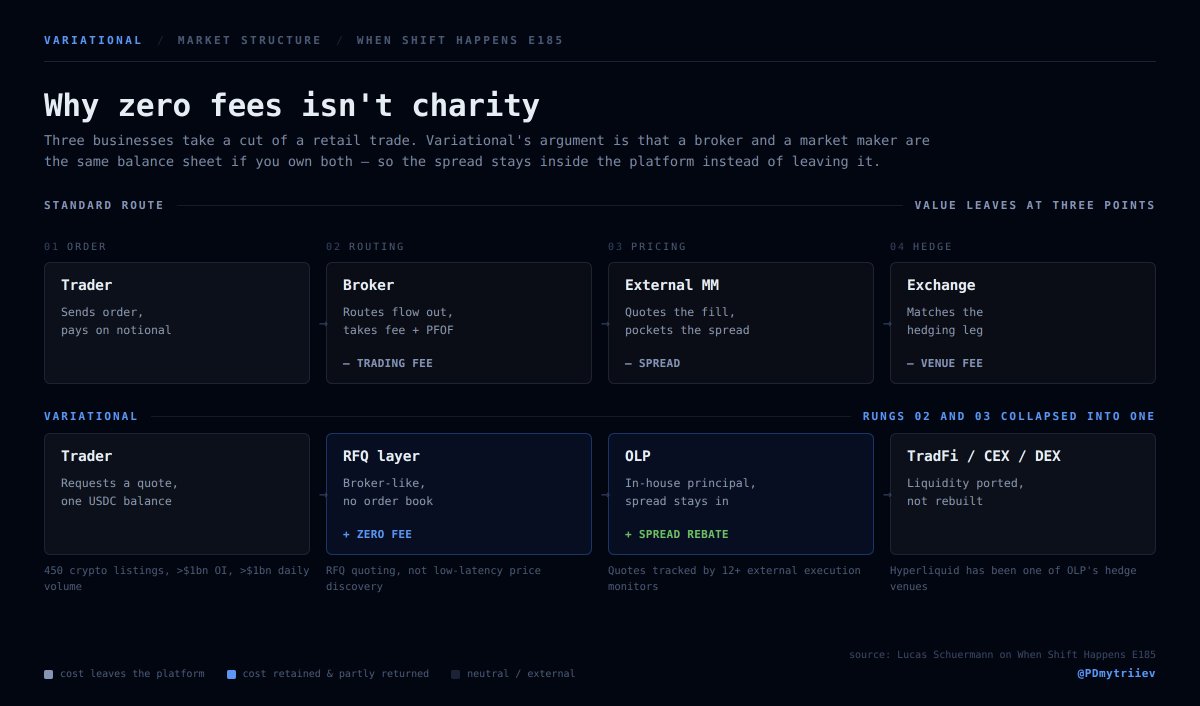
Zero fees works because @variational_io owns two of the three businesses that normally take a cut of your trade. Lucas Schuermann (@variational_lvs): university at 12, sold his quant fund to DCG at 21, now runs @variational_io at second place to @HyperliquidX in OI and volume, sat down with @KevinWSHPod for a conversation about architecture rather than metrics. → Zero fees is vertical integration, not charity. Exchanges, market makers and brokers each take a cut of a normal retail trade. Variational does the brokerage-style aggregation but keeps the market making in-house, so the spread never leaves the platform. That's what funds zero fees and what they're calling spread rebates. → On trusting a single market maker, his answer is transparency plus alignment: flows and P&L visible on-chain, at least 12 external sites tracking their execution quality, and a competitive market where bad fills get noticed immediately. → The structural argument is about liquidity, not fees. Order books rebuild liquidity from scratch for every listing, which works well for ten or twenty assets and breaks at hundreds. RFQ plus direct TradFi hedging ports liquidity instead. He's careful to credit Hyperliquid for proving the market and notes OLP has used it as a hedge venue. → He's honest about where the edge doesn't show: on the top five or ten markets at retail size, the two models are roughly comparable. The gap opens on the mid-pack, on larger orders, and on global markets. → Swaps are the real story. He refuses to quote an average perp funding rate because he doesn't think an honest one exists, majors might annualise 7-10%, RWA perps do whatever they want on a thin weekend. Swaps trade bilaterally at a flat carry cost he expects around 4-5% a year, and because that's how TradFi desks already face each other, it hedges straight into the underlying market. → The $50M raise in May was about counterparty credibility rather than runway. Getting institutions comfortable bridging liquidity on-chain takes balance sheet and warm introductions. → The risk he names himself: innovating on too many axes at once, new architecture, new instrument, new user base, and whether the product moat outweighs the switching and education cost.

Sunday, September 13, 2026 at 07:46 PM UTC
Discussion (0)
Connect wallet to join the discussion.