
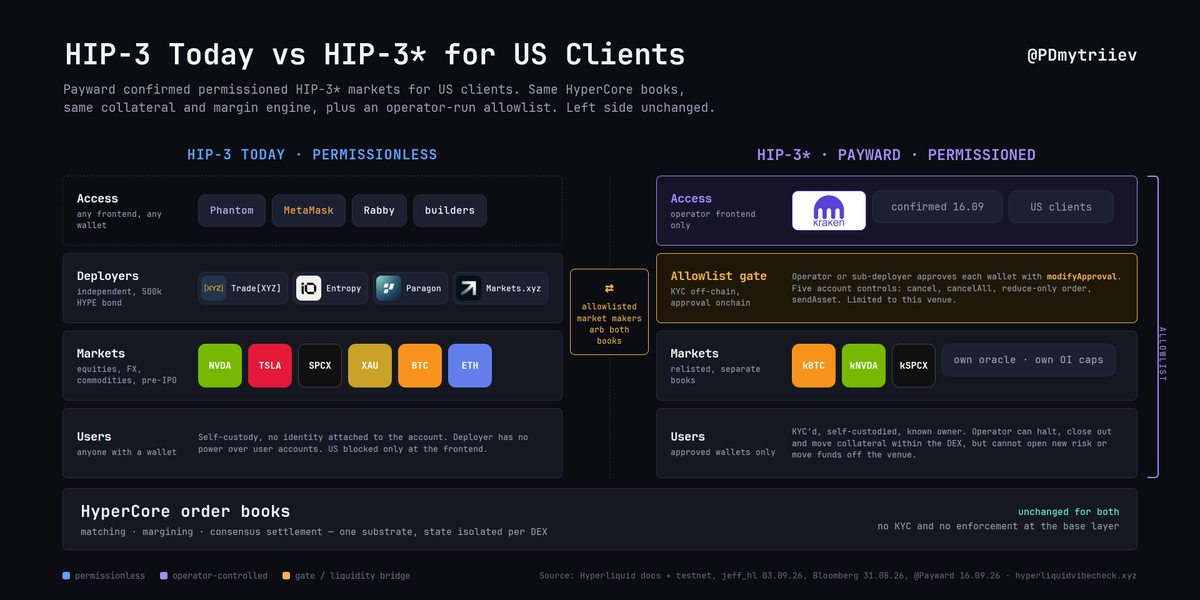
Payward just confirmed what the testnet was pointing at on 5 September: @krakenfx's parent is building permissioned HIP-3* markets on @HyperliquidX for US clients, which makes it the first licensed operator to put its name on the new layer. The reason Hyperliquid has been geoblocked from the US is that nobody in its stack could identify a customer, refuse one, or close one out. HyperCore already handles matching, clearing and margin, so the missing piece was a place where a regulated firm could carry those obligations. HIP-3* is that place, and a "Kraken HIP-3 test DEX" has been running it on testnet since 19 August. How it works: → A deployer flags a HIP-3 DEX as HIP-3* at creation, which turns on an onchain allowlist, so only wallets Payward has approved can trade on that venue. → The operator gets five account controls: add or remove a wallet, cancel specific orders, cancel all orders and TWAPs, place reduce-only orders, and move collateral between accounts inside the DEX. Each one can sit with a separate sub-deployer key, so KYC, surveillance and risk desks hold different permissions. → Those controls stop at the venue boundary. The operator cannot open new risk for a user, move funds off the DEX, or touch positions on any other DEX. → Markets are relisted as new contracts with their own order book, oracle and OI caps, but they share the same collateral and margin engine, so allowlisted market makers can arb against the open book. → The base layer doesn't change. HyperCore still has no KYC and no enforcement, existing markets and deployers are unaffected, and the protocol fee is charged on every trade.
Wednesday, September 16, 2026 at 12:47 PM UTC
Discussion (0)
Connect wallet to join the discussion.